
Waste generation is one of the most pressing environmental challenges of the modern era. Across the European Union (EU), shifting away from a traditional “take-make-waste” economic model toward a circular economy has become a top regulatory priority.
Guided by research and data from the European Environment Agency (EEA) and the European Commission, the EU has rolled out comprehensive policies to minimize landfill dependency, boost recycling rates, and force manufacturers to take accountability.
How effective are these policies? Here is a breakdown of the key steps Europe is taking to manage its waste—and whether these efforts are yielding real-world results.
The 6 Core Measures Driving European Waste Policy
1. Prioritizing Waste Prevention
At the heart of European waste strategy is the official EU Waste Hierarchy. This legally binding framework ranks waste management strategies in order of environmental preference:
- Prevention (Most preferred)
- Reuse
- Recycling
- Other Recovery (e.g., energy recovery)
- Disposal (Least preferred)
By placing prevention at the very top, EU law ensures that stopping waste before it is created takes priority over simply processing it later.
2. Expanding Recycling & Mandatory Separate Collection
To make high-grade recycling possible, EU regulations mandate that member states establish separate collection systems for major material streams, including:
- Paper and cardboard
- Metals
- Plastics
- Glass
Binding municipal recycling targets hold nations accountable. According to EEA data, 47.7% of municipal waste in Europe was successfully recycled in 2023.
3. Phasing Out Landfills
Landfills emit potent greenhouse gases like methane and leach toxic materials into soil and groundwater. To combat this, EU legislation has set strict goals:
- Limit municipal waste sent to landfills to 10% or less by 2035.
- Ban recyclable or recoverable waste from landfills starting in 2030.
These aggressive targets are already showing results: the EU-wide landfill rate dropped from 23% in 2010 to 17% in 2022.
4. Promoting Reuse and “Right to Repair” Networks
Under updated EU waste laws, member states must support local reuse, refurbished goods markets, and repair networks. Extending product lifespans keeps raw materials inside the economy longer, cutting emissions associated with manufacturing new goods from scratch.
5. Extended Producer Responsibility (EPR)
Through Extended Producer Responsibility (EPR) schemes, the financial and organizational burden of waste management shifts back to the manufacturers. Companies that design, produce, or sell products in the EU are financially responsible for collecting, sorting, and treating those products once they reach the end of their lifecycle.
6. Targeting High-Impact Sectors: Food and Textiles
Textiles and food waste represent two of the most resource-intensive supply chains in the world. Revisions to the EU Waste Framework Directive introduced binding food-waste reduction targets for all EU Member States, alongside stricter rules governing textile waste collection and management.
Is the EU Waste Strategy Working?
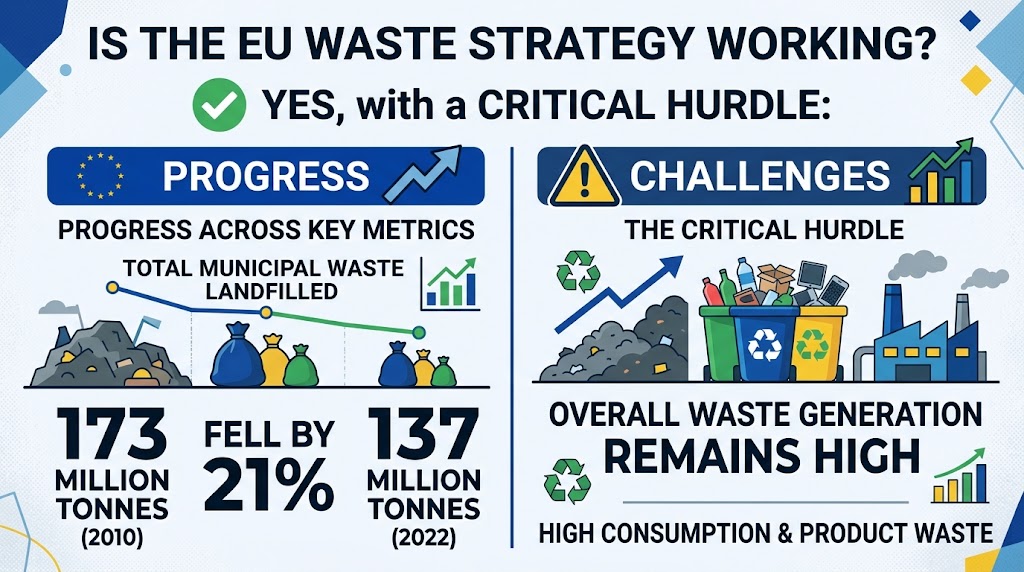
The short answer: Yes, but overall waste generation remains a critical hurdle.
Progress across key metrics is measurable. Between 2010 and 2022, total municipal waste landfilled in the EU fell by 21%, dropping from 173 million tonnes to 137 million tonnes.
Landfill Rate:     23% (2010) ---> 17% (2022)
Municipal Recycled: 47.7% (2023)
Target Landfill:   < 10% (by 2035)
However, the EEA cautions that despite higher recycling efficiency and falling landfill rates, total consumption—and therefore total waste generation—remains high across Europe. Additionally, the rapid growth in recycling rates observed over the past decade has recently begun to plateau.
To achieve a true circular economy, European policy will need to focus even more aggressively on absolute reduction at the consumer and industrial level.
Primary Official Sources
- European Commission — Waste Framework Directive
- European Environment Agency (EEA) — Waste recycling in Europe
- European Environment Agency (EEA) — Diversion of waste from landfill
- EUR-Lex — EU Waste Framework Directive (Legislation Portal)